
If your students freeze the moment they see a word problem, you’re not alone. Word problems combine reading, comprehension, vocabulary, and math, which for many elementary students, that’s a lot to juggle.
That’s exactly why I created a simple, student-friendly routine called High 5 for Problem Solving.
It gives students a clear path from confusion to solution, and because it’s only five steps, they can quickly learn it, remember it, and apply it independently.
Here’s a breakdown of the steps and how you can start using them in your classroom tomorrow.
High 5 for Problem Solving
Five steps to problem solving success:
- Visualize the Story
- Write a Number Sentence
- Pick a Strategy
- Solve
- Write a Sentence
This problem-solving strategy for elementary math students includes five steps to guide students through a logical, repeatable routine that supports comprehension, strategy selection, computation, and communication. Let’s break it down!

1: Visualize the Story
This is where students make sense of the problem, before touching numbers or operations.
Encourage them to:
- Picture the story
- Identify characters, actions, and quantities
- Draw a quick sketch or model
Visualization reduces overwhelm and anchors the math in meaning. It gives students a context to understand the situation and makes the problem more meaningful for them.
2: Write the Number Sentence(s)
Now students turn the words into math. This is where the translation is usually misunderstood. I teach students to recognize the numbers and put them in a bar model.
This step helps them define:
- What they know
- What they need to find
- What operation makes sense
The number sentence acts as a roadmap for the rest of the problem.
3: Pick a Strategy
This is where students choose how they’re going to solve it, rather than randomly guessing.
Common strategies include:
- Drawing a model
- Using an open number line (my class’s current favorite!)
- Making a table
- Breaking apart numbers
- Using manipulatives
- Acting it out
- Using an array or area model
- Estimating first
Giving students choice here builds confidence and ownership.
4: Solve
Now they put the strategy into action.
During this step, students should:
- Show their work
- Check if their answer makes sense
- Revisit their number sentence for accuracy
5: Write a Sentence
This final step ties everything together. This is where my students fall flat, and I know that I am not alone.
Students write a complete sentence that:
- Answers the question
- Includes the unit/label
- Connects back to the story
This reinforces comprehension and helps teachers assess understanding.
Want a Ready-to-Use Classroom Set?
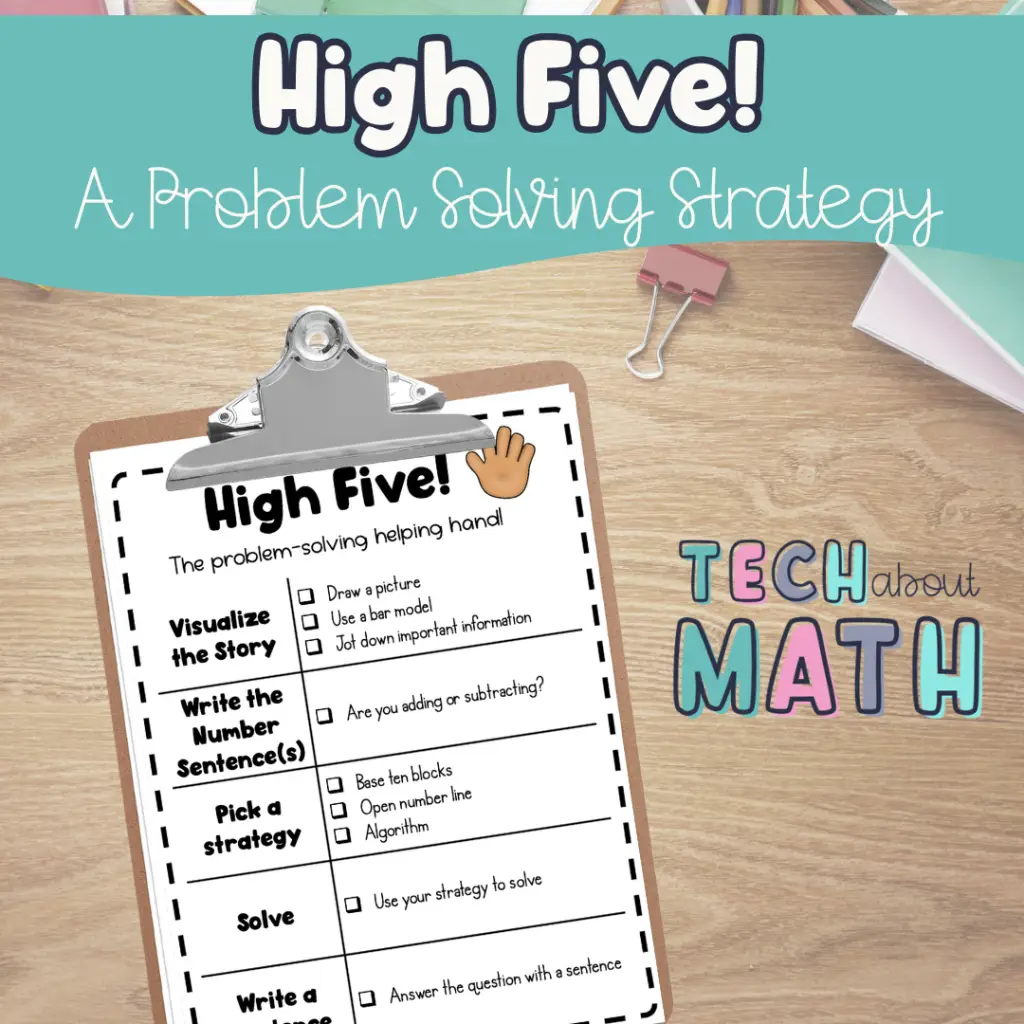
To make implementation easier, I created a High 5 for Problem Solving Classroom Kit that includes:
- A poster you can hang in your math center or on your whiteboard
- A student checklist they can keep in notebooks or inside math folders
- A worked-out example that models the steps in action
You can grab it here if you want everything prepped and ready.
Final Thoughts
Teaching problem-solving strategies for elementary math students doesn’t have to be overwhelming, they just need a clear process that encourages understanding over guessing. High 5 for Problem for Solving gives them exactly that. If you’re wondering how to scaffold other skills specifically, check out this blog post where I talk about using other scaffolds in your math classroom.
alexandra
